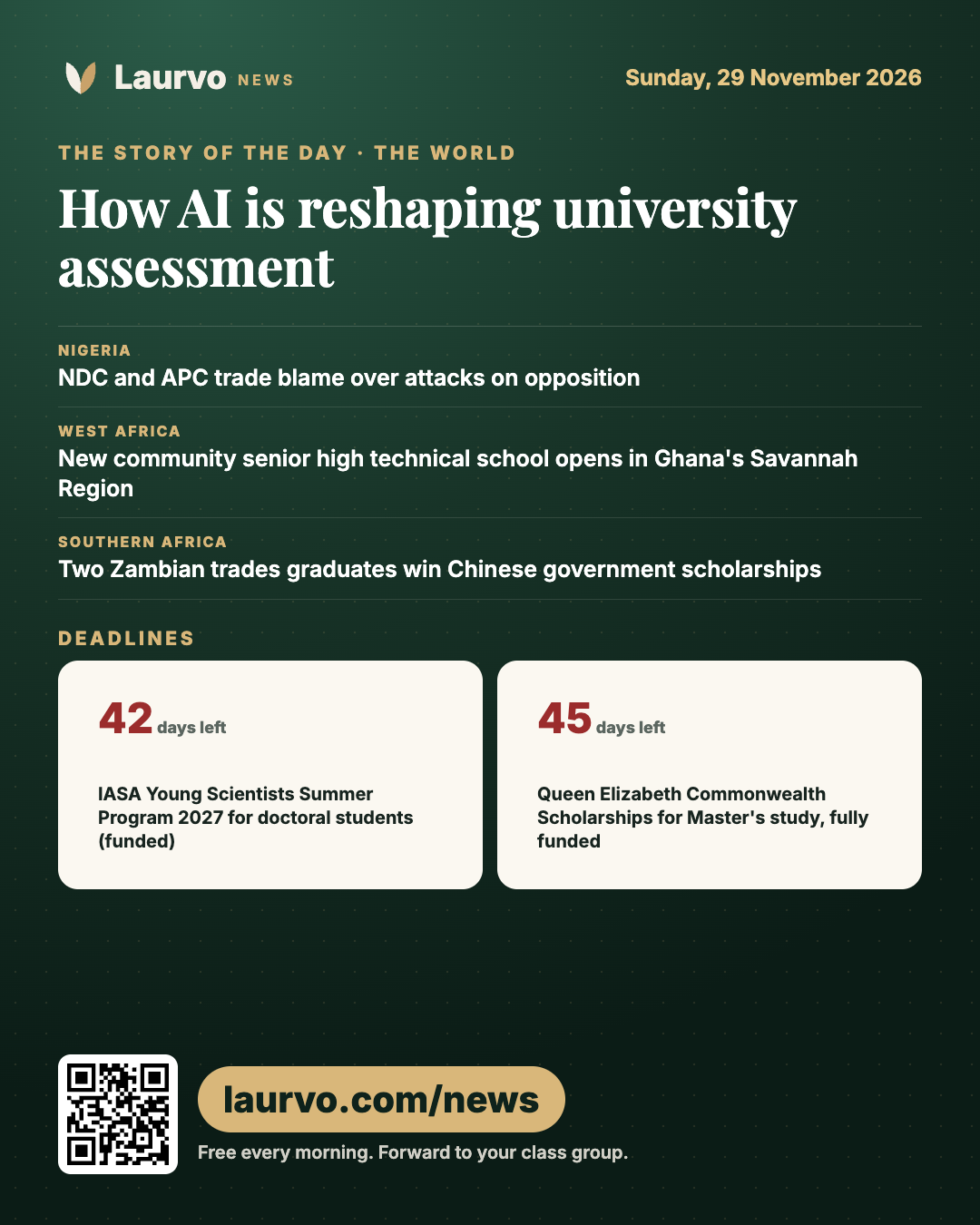
News that affects your studies, scholarships and opportunities matched to you, and a daily skill for reading, thinking, writing and presenting more powerfully. Bookmark this page: it is your one-stop shop.
Today's brief looks at how AI is changing university assessment and exams, along with school access and digital skills in Ghana. It also covers election tensions in Nigeria and a strong set of funded fellowships and scholarships for African students.
Scholarships, fellowships, grants, competitions, programmes and conferences for students in Africa, kept here until they close. 88 open now.
ProgrammeAcross AfricaCloses in 1 dayMatches you
Accountability Lab East and Southern Africa has opened applications for its 2027 Digital Governance Incubator Program for emerging young leaders.
Deadline: 29 November 2026, 23:59 CAT
Why it matters: Builds skills in digital governance, with a deadline just over a week away.
accountabilitylab.org · added 21 November 2026
ScholarshipSouth AfricaCloses in 2 daysMatches you
Applications are open for the 2027 Funza Lushaka Bursary Programme for young South Africans.
Deadline: 30 November 2026
Why it matters: Bursary funding can decide whether a student starts or continues studying.
education.gov.za · added 20 November 2026
CompetitionOpen worldwideCloses in 2 daysMatches you
The FAO is accepting entries for a video challenge built around five types of innovation. It is open to students, young professionals and creatives worldwide.
Deadline: November 30th, 2026
Why it matters: A chance to practise presenting an idea clearly and publicly.
fao.org · added 19 November 2026
FellowshipAcross AfricaCloses in 2 daysMatches you
The Johannesburg Institute for Advanced Study is accepting applications for its two-month writing fellowships. They are open to academics, researchers, writers and other professionals, and are fully funded.
Deadline: 30 November 2026
Why it matters: Protected time and funding to develop serious writing.
forms.cloud.microsoft · added 10 November 2026
FellowshipNigeriaCloses in 2 daysMatches you
The fellowship is open to emerging writers, storytellers and spoken word artists. It is run by the Poetic Wednesdays Initiative with support from the Nigeria Youth Futures Fund.
Deadline: November 30, 2026
Why it matters: Offers structured development in writing and advocacy for young creatives.
Opportunity Desk · added 8 November 2026
GrantPostgraduateOpen worldwideCloses in 2 daysMatches you
Cohort 4 of the Microsoft AI Economy Institute is open to researchers worldwide. It supports independent, policy-relevant research.
Deadline: 30 November 2026
Why it matters: A sizeable grant for researchers working on AI and the economy.
microsoft.com · added 7 November 2026
ProgrammeOpen worldwideCloses in 2 daysMatches you
CISPA offers a paid research internship of two to three months for BSc or MSc students. Interns work alongside leading researchers in cryptography, computer security, privacy and machine learning or AI.
Deadline: 30 November 2026
Why it matters: Paid early research experience in a competitive and growing field.
apply.internships.cispa.de · added 5 November 2026
ConferenceOpen worldwideCloses in 2 daysMatches you
Submissions are invited for a 2027 conference on how artificial intelligence is reshaping how work is organised, performed, valued and governed.
Deadline: November 30, 2026
Why it matters: A chance for researchers to present work on AI and society.
Opportunity Desk · added 3 November 2026
ScholarshipUndergraduateNigeriaCloses in 2 daysMatches you
Applications are open for the 2026 NNPC/SNEPCo National University Scholarship Programme for young Nigerian students. SNEPCo runs it on behalf of itself and NNPC.
Deadline: 30 November 2026
Why it matters: Funding for university study can ease fee pressure for Nigerian undergraduates.
candidate.scholastica.ng · added 29 October 2026
GrantAcross AfricaCloses in 3 daysMatches you
The Earth Journalism Network is offering US$20,000 in grants for stories on mining, environment and human rights in Africa.
Deadline: December 1, 2026, 12:59 PM (Africa/Accra)
Why it matters: Funds investigative writing and research on issues affecting African communities.
earthjournalism.net · added 19 November 2026
FellowshipOpen worldwideCloses in 3 daysMatches you
The programme is hosted by the Center for Universal Education at Brookings in Washington D.C. It is fully funded and carries a $26,500 stipend.
Deadline: 1 December 2026
Why it matters: A funded research placement at a leading policy institution.
brookings.edu · added 16 October 2026
ProgrammeOpen worldwideCloses in 5 daysMatches you
Applications are open for the bootcamp, designed for young people with a climate-focused interest or idea.
Deadline: December 3rd, 2026
Why it matters: Closing soon, and builds practical climate innovation skills.
learn.dotrust.org · added 26 November 2026
ConferencePostgraduateOpen worldwideCloses in 7 daysMatches you
Early career researchers are invited to submit abstracts for a pre-conference workshop in São Paulo, Brazil, on innovation, institutions and inclusion.
Deadline: 5 December 2026
Why it matters: Builds research presentation skills and connects early career researchers with peers.
winir.org · added 24 November 2026
FellowshipAcross AfricaCloses in 9 daysMatches you
The fellowship brings together emerging African researchers, professionals and changemakers to explore digital rights, emerging technologies and the policies affecting connected societies.
Deadline: 7 December 2026
Why it matters: Builds research skills on technology and policy in Africa.
Opportunity Desk · added 17 November 2026
FellowshipUndergraduateNigeriaCloses in 9 daysMatches you
The 2026/2027 fellowship supports Nigerian students studying technology-related degree programmes. It is described as fully funded.
Deadline: 7 December 2026
Why it matters: Covers study costs for Nigerian undergraduates in technology fields.
apply.theafarainitiative.org · added 10 November 2026
ScholarshipPostgraduateOpen worldwideCloses in 10 daysMatches you
Applications are open for fully funded, full-time Master's study in the United Kingdom. The programme is one of three Master's schemes offered by the Commonwealth.
Deadline: 8 December 2026
Why it matters: A fully funded route to postgraduate study abroad.
cscuk.fcdo.gov.uk · added 11 November 2026
ScholarshipAcross AfricaCloses in 12 daysMatches you
The Bertha Centre and the Faculty of Health Sciences at the University of Cape Town invite applications for the 2027 scholarship, funded by the Mastercard Foundation Healthy Futures Project.
Deadline: December 10, 2026
Why it matters: A funded opening for African changemakers in health and social innovation.
uct.ac.za · added 19 November 2026
GrantPostgraduateOpen worldwideCloses in 13 daysMatches you
The grant invites researchers worldwide to propose early-stage studies on social connection among Gen Z, roughly ages 14 to 29. It can fund pilot, exploratory or feasibility studies.
Deadline: 11 December 2026
Why it matters: A chance to fund a small research project on a social science topic.
static1.squarespace.com · added 22 November 2026
FellowshipAcross AfricaMatches you
A funded, 10-month professional training programme for African innovators working on health innovation. Applications are open.
Deadline: 13 December 2026
Why it matters: Builds practical health innovation skills alongside funding.
eabiodesign.org · added 23 November 2026
ScholarshipPostgraduateAcross AfricaMatches you
The fully funded programme is designed for students from the African continent who want a two-year Master's degree at Sciences Po. Several Master's programmes are available.
Deadline: December 14, 2026
Why it matters: A funded route to a master's degree abroad for African graduates.
apply.semantikmatch.com · added 1 November 2026
ScholarshipPostgraduateAcross AfricaMatches you
Applications are open for the Sciences Po Mastercard Foundation Scholars Program, a fully funded route to graduate study in France.
Deadline: 14 December 2026
Why it matters: A fully funded graduate place with a clear deadline.
sciencespo.fr · added 28 October 2026
ProgrammeUndergraduateOpen worldwideMatches you
This fully funded, three-week programme is designed for undergraduate juniors exploring public service careers.
Deadline: December 15, 2026
Why it matters: Builds policy and professional skills at no cost to selected students.
volckeralliance.qualtrics.com · added 19 November 2026
FellowshipPostgraduateEast AfricaMatches you
The fellowships support master's study on human-wildlife conflict and coexistence in Uganda, with funding of up to $15,000.
Deadline: 15 December 2026
Why it matters: Funding for graduate conservation research with a clear regional focus.
wwf.submittable.com · added 17 October 2026
FellowshipPostgraduateOpen worldwideMatches you
Applications are open for master's or doctoral students. The fellowship is worth $15,000 per year.
Deadline: 15 December 2026, 11:59 PM U.S. ET
Why it matters: Funding for postgraduate study, with a deadline in December.
worldwildlife.org · added 16 October 2026
ProgrammeAcross AfricaMatches you
Applications are open for the 2027 Young Leaders Program of the French-African Foundation for young Africans. It is fully funded and takes place in France.
Deadline: December 16, 2026
Why it matters: Offers funded international networking and leadership experience.
french-african.org · added 19 November 2026
ScholarshipUndergraduateAcross AfricaMatches you
The WAAW Foundation Scholarship supports female college students in Africa with a $500 award. Applications are now open.
Deadline: December 18, 2026
Why it matters: Direct financial support for women undergraduates across Africa.
waawfoundation.org · added 3 November 2026
CompetitionOpen worldwideMatches you
Applications are open for a challenge supporting youth-led solutions, with $90,000 in funding available.
Deadline: 18 December 2026
Why it matters: A funded chance to develop and pitch a practical solution to a community problem.
socialshifters.co · added 17 October 2026
ScholarshipSouth AfricaMatches you
The PPS Foundation has opened applications for its 2027 bursary programme for young South African students.
Deadline: 20 December 2026
Why it matters: Bursaries can ease fees for the 2027 academic year.
app.i-me.tech · added 22 November 2026
FellowshipPostgraduateOpen worldwideMatches you
An early-career, cohort-based postdoctoral training programme at the Institute for Health Metrics and Evaluation in Seattle, for researchers who want careers in health metrics.
Deadline: December 21, 2026
Why it matters: Training route for early-career health researchers.
apply.interfolio.com · added 1 November 2026
FellowshipPostgraduateAcross AfricaMatches you
Yale's Council on African Studies and the MacMillan Center invite applications for the Visiting African Scholars Fellowship for the 2027-2028 academic year.
Deadline: 31 December 2026
Why it matters: A visiting fellowship for African academics and early-career researchers seeking time at Yale.
africanstudies.org · added 24 November 2026
ScholarshipPostgraduateAcross AfricaMatches you
The programme enables talented young Africans to pursue a master's degree at the University of Cambridge. It aims to help them grow their leadership potential.
Deadline: 31 December 2026
Why it matters: A route to postgraduate study at a leading university for African students.
mastercardfoundation.fund.cam.ac.uk · added 22 November 2026
ScholarshipPostgraduateWest AfricaMatches you
The West African Health Organisation, with partners, is accepting applications for its 2026/2027 doctoral and master's scholarships in public health.
Deadline: December 31st, 2026
Why it matters: Funding for postgraduate public health study in West Africa.
wahooas.org · added 18 November 2026
ScholarshipPostgraduateOpen worldwideMatches you
The programme offers fully funded graduate scholarships together with leadership development, long-term mentoring and networking.
Deadline: January 6, 2027
Why it matters: Full funding for postgraduate study with a leadership and mentoring component.
Opportunity Desk · added 18 October 2026
ScholarshipPostgraduateOpen worldwideMatches you
Applications are open for the funded Eiffel Excellence Scholarship, which supports master's and doctoral study in France.
Deadline: January 6, 2027
Why it matters: A funded route to postgraduate study in France.
campusfrance.org · added 15 October 2026
ScholarshipPostgraduateAcross AfricaMatches you
Egypt-Japan University of Science and Technology offers a fully funded TICAD9 African scholarship for postgraduate study in science, technology and innovation.
Deadline: January 10, 2027
Why it matters: Fully funded postgraduate study open to African graduates.
ejust.edu.eg · added 13 November 2026
ScholarshipPostgraduateOpen worldwideMatches you
Applications are open for the fully funded 2027/2029 Erasmus Mundus master's scholarship in journalism, media and globalisation, with study in Europe.
Deadline: 10 January 2027 at 13.00 CET
Why it matters: A fully funded master's route for students interested in media and writing.
mundusjournalism.com · added 3 November 2026
ProgrammeOpen worldwideMatches you
The International Institute for Applied Systems Analysis has opened applications for its 2027 Young Scientists Summer Program.
Deadline: 10 January 2027, 23:00 CET
Why it matters: A chance to gain international research experience early in a career.
iiasa.ac.at · added 20 October 2026
ScholarshipPostgraduateOpen worldwideMatches you
The fully funded scholarships support master's degree study in a low or middle-income Commonwealth country. Applications for 2027/2028 are open.
Deadline: 13 January 2027, 15:00 UTC
Why it matters: A fully funded master's route, with a deadline soon after the new year.
uneswa.ac.sz · added 28 November 2026
GrantPostgraduateAcross AfricaMatches you
The awards support African doctoral candidates whose research looks at aspects of violence on or directly related to the African continent. Grants are worth $10,000.
Deadline: January 15, 2027
Why it matters: Direct research funding for African PhD students.
grantinterface.com · added 29 November 2026
GrantPostgraduateAcross AfricaMatches you
Applications are open for the 2027/2028 Harry Frank Guggenheim African Fellow Awards, which give research grants of $10,000 to African doctoral candidates.
Deadline: January 15, 2027
Why it matters: Direct research funding for doctoral students working on their dissertations.
hfg.org · added 28 November 2026
GrantPostgraduateAcross AfricaMatches you
The fund invites pairs of researchers, at post-doctoral level and above, from Cambridge and African universities in any discipline. It supports collaborations on climate resilience.
Deadline: January 15, 2027
Why it matters: Supports African researchers building climate research partnerships.
cambridge-africa.cam.ac.uk · added 21 November 2026
GrantPostgraduateAcross AfricaMatches you
Applications are invited from pairs of researchers, at post-doctoral level and above, for the 2026/2027 Cambridge Africa Climate Collaborative Research Fund.
Deadline: 15 January 2027
Why it matters: Supports joint climate research by African researchers.
cambridge-africa.cam.ac.uk · added 20 November 2026
ScholarshipPostgraduateOpen worldwideMatches you
This fully funded scholarship supports women who want to study in Sweden and build their capacity to lead innovation. Applications are now open.
Deadline: 15 January 2027
Why it matters: Fully funded study for women in STEM, with ample time to apply.
si.se · added 25 October 2026
ScholarshipPostgraduateOpen worldwideMatches you
Applications are open for the 2027 Swedish Institute Scholarships for Global Professionals, which fund master's level study in Sweden. The scholarship is described as fully funded.
Deadline: 15 January 2027
Why it matters: A fully funded master's option with time to prepare a strong application.
si.se · added 23 October 2026
FellowshipPostgraduateAcross AfricaMatches you
The Social Science Research Council's APDD programme invites applications for its 2027 fellowships. They aim to improve the quality and visibility of independent African peacebuilding research.
Deadline: 15 January 2027
Why it matters: Supports African researchers working on peacebuilding and development.
ssrc.secure-platform.com · added 19 October 2026
FellowshipAcross AfricaMatches you
The Social Science Research Council's APDD programme invites applications from African researchers for its 2027 Individual Research Fellowships.
Deadline: 15 January 2027
Why it matters: A research fellowship aimed specifically at African scholars.
ssrc.org · added 16 October 2026
GrantPostgraduateAcross AfricaMatches you
CODESRIA invites proposals from researchers in African universities and research institutions. Topics include higher education, gender, academic freedom and the quality of associational life, with support from the Andrew Carnegie Foundation.
Deadline: 16 January 2027
Why it matters: Funding for research on African higher education, open to researchers across the continent.
apply.codesria.org · added 28 October 2026
FellowshipAcross AfricaMatches you
Applications are open for the Center for Effective Global Action fellowship. It offers a monetary stipend and a fully funded residency at UC Berkeley.
Deadline: 17 January 2027, 5 PM GMT
Why it matters: A funded route to research time and international networks for African researchers.
cega.berkeley.edu · added 12 November 2026
FellowshipPostgraduateAcross AfricaMatches you
The Center for Effective Global Action invites African researchers and practitioners to apply. The fellowship develops skills in impact evaluation and runs in Fall 2027 or Spring 2028.
Deadline: January 17, 2027
Why it matters: Builds research skills for early-career African researchers.
cega.submittable.com · added 9 November 2026
FellowshipPostgraduateAcross AfricaMatches you
The Center for Effective Global Action invites African researchers to apply for its 2027/2028 Visiting Fellowship.
Deadline: 17 January 2027
Why it matters: Offers African researchers a place in an international research network.
cega.submittable.com · added 7 November 2026
FellowshipPostgraduateOpen worldwideMatches you
The Bayer Foundation offers fellowships for outstanding Master's, PhD and medical students. The grant of up to €10,000 supports international research projects and placements.
Deadline: January 18, 2027
Why it matters: Extra funding for international research experience during postgraduate study.
bayer-foundation.com · added 15 November 2026
ProgrammeUndergraduateOpen worldwideMatches you
A competitive summer research programme that prepares undergraduate students for graduate study at MIT and beyond. A stipend is available.
Deadline: January 19, 2027
Why it matters: Hands-on research experience strengthens later postgraduate applications.
program-connect.mit.edu · added 1 November 2026
CompetitionOpen worldwideMatches you
The European Space Agency's award celebrates early-career researchers who use Earth observation satellite data to advance science and applications. Awards are worth up to €15,000.
Deadline: 22 January 2027
Why it matters: Recognises early-career researchers and could support work in environmental science.
email.azo-space.com · added 25 November 2026
FellowshipPostgraduateOpen worldwideMatches you
The Centre for Research in the Arts, Humanities and Social Sciences at the University of Cambridge invites applications for funded Visiting Fellowships for scholars from the Global South.
Deadline: January 22, 2027
Why it matters: Funded research time at a leading centre for early-career scholars.
app.casc.cam.ac.uk · added 6 November 2026
CompetitionAcross AfricaMatches you
Applications are open for the 2027 Caine Prize Award for African writing, which carries a £10,000 cash prize. The deadline is 12:00 GMT on Monday, 25 January 2027.
Deadline: 25 January 2027, 12:00 GMT
Why it matters: A major prize for African writers wanting to build and show their writing.
caineprize.com · added 25 November 2026
ProgrammeOpen worldwideMatches you
A global call is open for young researchers to join the 2027/2029 FAO World Food Forum Young Scientists Group, which was launched in 2022.
Deadline: 29 January 2027 23:59 CET
Why it matters: Lets early-career researchers join an international scientific network.
youth.world-food-forum.org · added 15 October 2026
ScholarshipPostgraduateNigeriaMatches you
The 2027/2028 NNPC Limited and TotalEnergies International Scholarship sponsors young Nigerian scholars for Master's study in France. It is fully funded.
Deadline: 31 January 2027
Why it matters: Fully funded postgraduate study abroad for Nigerian students.
csr-ngscholarship.totalenergies.com · added 13 November 2026
CompetitionOpen worldwideMatches you
Entrants can compete for a CHF 20,000 prize and expenses-paid participation in the 56th St. Gallen Symposium in Switzerland.
Deadline: 1 February 2027
Why it matters: Builds idea development and presentation skills, with travel paid.
symposium.org · added 3 November 2026
ConferenceOpen worldwideMatches you
Applications are open for the 2027 forum in Heidelberg, Germany, for young researchers in mathematics and computer science. A travel grant is available.
Deadline: February 11, 2027, 11:59 p.m. Berlin time
Why it matters: A chance to meet leading researchers and present yourself internationally.
newsroom.hlf-foundation.org · added 26 November 2026
FellowshipPostgraduateAcross AfricaMatches you
The African Research Universities Alliance is accepting applications for its 2027 fellowship for early-career African researchers. It is fully funded and includes a monthly stipend of US$2,000.
Deadline: 15 February 2027
Why it matters: A funded route for early-career researchers to build their research careers.
arua.org · added 28 November 2026
FellowshipPostgraduateAcross AfricaMatches you
Applications are open for the fully funded 2027 Iso Lomso Fellowships, which support early-career researchers from Africa.
Deadline: 15 February 2027
Why it matters: A funded route for emerging African researchers to build a research career.
stias.ac.za · added 26 November 2026
ScholarshipPostgraduateOpen worldwideMatches you
Applications are open for the 2027 ANSO-CAS-TWAS/UNESCO PhD Scholarship, offered under an agreement between the Alliance of International Science Organizations and the Chinese Academy of Sciences. It is for students and scholars from developing countries.
Deadline: 28 February 2027
Why it matters: A funded doctoral opportunity open to applicants from across Africa.
twas.org · added 25 November 2026
ScholarshipPostgraduateOpen worldwideMatches you
Applications are open for the 2027/2028 VLIR-UOS ICP Connect scholarships for master's programmes in Belgium. The programmes aim to equip students to become leaders and change agents.
Deadline: 28 February 2027
Why it matters: A fully funded master's route abroad, with plenty of time to prepare.
vliruos.be · added 27 October 2026
ScholarshipAcross AfricaMatches you
The Government of Mauritius invites applications for its 2027 Africa Scholarships Scheme, a fully funded opportunity to study in Mauritius.
Deadline: 31 March 2027
Why it matters: A fully funded route to study in another African country, with a long lead time.
tertiaryeducation.govmu.org · added 4 November 2026
ScholarshipPostgraduateOpen worldwideMatches you
A limited number of stipends are offered through the Bridging Divides programme. They are open to full-time master's and PhD students studying or applying to study at Toronto Metropolitan University on a migration-related topic.
Deadline: 1 April 2027
Why it matters: Stipend support for postgraduate research on migration.
Opportunity Desk · added 16 October 2026
ScholarshipAcross AfricaMatches you
Applications are open for the 2027 Mastercard Foundation Scholars Program at the American University of Cairo, listed as fully funded.
Deadline: May 6, 2027
Why it matters: A fully funded route to study at a leading university in Egypt.
aucegypt.edu · added 31 October 2026
ScholarshipPostgraduateOpen worldwideMatches you
Ghent University offers 15 funded PhD sandwich scholarships a year, supported by its Special Research Fund, for candidates from the Global South to study in Belgium.
Why it matters: Funded doctoral study in Europe for candidates from the Global South.
ugent.be · added 26 November 2026
JobWest AfricaMatches you
The service invites graduates with a Bachelor of Education degree or related education certificates to apply for teaching positions through its recruitment portal.
Deadline: 2 December
Why it matters: A near-term job route for education graduates in Ghana.
Daily Graphic · added 26 November 2026
ProgrammeOpen worldwideMatches you
The Vienna BioCenter's nine-week summer research programme is accepting applications from bachelor's and master's students worldwide. It is fully funded.
Why it matters: Gives hands-on research experience at a leading European centre.
training.vbc.ac.at · added 25 November 2026
ProgrammeOpen worldwideMatches you
A fully funded six-day intensive programme at Fast Retailing's headquarters in Tokyo, open to students from all over the world.
Why it matters: A funded short programme in management for students worldwide.
fastretailing.com · added 22 November 2026
ScholarshipPostgraduateAcross AfricaMatches you
Applications are open for the fully funded 2027/2028 Cambridge Mastercard Foundation Scholars Programme for young Africans. Deadlines vary by course.
Deadline: Varies by course
Why it matters: Fully funded study at Cambridge for African applicants.
mastercardfoundation.fund.cam.ac.uk · added 21 November 2026
ProgrammeOpen worldwideMatches you
The programme welcomes international students from around the world for about eight weeks in Germany between July and September 2027. It is fully funded.
Why it matters: A funded research placement abroad, open to students worldwide.
hzdr.de · added 21 November 2026
ScholarshipPostgraduateOpen worldwideMatches you
The European Master in Law and Economics is a fully funded one-year master's studied at three or more universities in Europe and beyond. Final-year students can also apply.
Why it matters: A fully funded route to a postgraduate degree abroad.
Opportunities Corners · added 20 November 2026
CompetitionUndergraduateNigeriaMatches you
The BusinessDay Young Economists Writing Challenge 2027 is for Nigerian undergraduate economics students.
Why it matters: A chance to practise and publish economics writing.
Opportunities For Africans · added 14 November 2026
ProgrammeOpen worldwideMatches you
UTRIP is a six-week, fully funded summer internship hosted by the University of Tokyo, open to applicants of all nationalities. It runs from 23 June to 3 August 2027.
Why it matters: Open to all nationalities and fully funded, with research experience abroad.
s.u-tokyo.ac.jp · added 13 November 2026
ProgrammeOpen worldwideMatches you
CERN brings about 300 students from around the world to Geneva each year. Candidates of all nationalities may apply.
Why it matters: Hands-on science experience at a leading research organisation.
careers.cern · added 11 November 2026
ProgrammeUndergraduateOpen worldwideMatches you
Stanford's eight-week summer programme is for undergraduates interested in doctoral studies and research careers in engineering. Stanford Engineering will cover all participation-related expenses, including transport and accommodation.
Why it matters: A fully funded way to gain research experience before postgraduate study.
engineering.stanford.edu · added 10 November 2026
FellowshipOpen worldwideMatches you
ETH Zurich's Computer Science Department offers a fully funded two-month research internship for undergraduate and graduate students. It is open to students worldwide.
Why it matters: Gives hands-on research experience abroad at no cost to the student.
sirop.org · added 4 November 2026
ScholarshipPostgraduateOpen worldwideMatches you
This two-year joint master's programme brings together five European universities across four countries. It is funded under Erasmus Mundus and welcomes students from all around the world.
Why it matters: A fully funded European master's for agriculture and plant science students.
planthealth.upv.es · added 1 November 2026
FellowshipOpen worldwideMatches you
A fully funded two-week study programme in Berlin and Poland. It is open to enrolled students, recent graduates and early-career professionals from any country.
Why it matters: No nationality restrictions, so African students can apply.
faspe-ethics.org · added 31 October 2026
ScholarshipAcross AfricaMatches you
The African Leadership College of Higher Education, with the Mastercard Foundation, offers fully funded scholarships to talented students across the continent. The deadline is not specified.
Why it matters: A fully funded study place open to students from across Africa.
alueducation.formtitan.com · added 30 October 2026
FellowshipOpen worldwideMatches you
The Alexander von Humboldt Institute for Internet and Society offers a ten-week fully funded fellowship for researchers, journalists and other professionals to study how AI affects society and the environment.
Why it matters: Builds research skills on a major topic and gives experience abroad.
hiig.de · added 30 October 2026
ScholarshipPostgraduateSouth AfricaMatches you
Applications are open for the 2027 SA-CERN Programme Excellence MSc/PhD Bursary. The national programme is funded by the Department of Science and Innovation and others.
Why it matters: A route to funded postgraduate research for young South Africans.
tlabs.ac.za · added 29 October 2026
ProgrammeOpen worldwideMatches you
The three-month Computation and Cognition Tübingen Summer Internship offers hands-on research experience. Interns receive about €1,350 monthly, accommodation, health insurance and travel costs.
Why it matters: Fully funded research experience for students interested in computation and cognition.
projects.tuebingen.mpg.de · added 28 October 2026
ProgrammePostgraduateOpen worldwideMatches you
The free training takes place in Nice from 20 to 23 July 2027. It is organised by the WHO Regional Office for Europe, a WHO Collaborating Centre at Université Côte d'Azur and Ulysseus European University, and is designed for PhD students.
Why it matters: Free research training with international health experts for doctoral students.
who.int · added 25 October 2026
CompetitionOpen worldwideMatches you
Applications are open for the Global Debate Championship, Harvard Merdeka Edition, in Kuala Lumpur. The five-day event brings together young debaters and students for parliamentary debate and diplomacy.
Why it matters: Builds argument and public speaking skills at an international event.
europeanvoiceassembly.org · added 22 October 2026
ScholarshipPostgraduateOpen worldwideMatches you
The Asian Development Bank offers a fully funded master's scholarship at Keio University in Tokyo for April or September 2027 entry. Applicants must first apply to Keio's International Graduate Programs.
Why it matters: A fully funded route to postgraduate study abroad.
keio.ac.jp · added 19 October 2026
ScholarshipPostgraduateOpen worldwideMatches you
The Japanese government scholarship is open to applicants for a master's or PhD degree starting in October 2027. The University of Tokyo has 15 graduate schools.
Why it matters: A fully funded route to postgraduate study abroad.
Opportunities Corners · added 16 October 2026
A short lesson every morning, with a ten-minute exercise. Including how assessment works in the age of AI.
ReadingRead for the claim before the evidence
Before reading a journal article in full, read the title, abstract and final paragraph, then write one sentence: "The author argues that X because Y." This gives you a map, so details stop feeling random. Example: "The author argues that rural clinics lose staff because of housing, not pay." While reading, mark only lines that support or weaken that sentence. If you cannot finish the sentence afterwards, you have not understood yet. Reread the methods or discussion instead of highlighting more.
Try: Pick one article from your reading list. In ten minutes, read its abstract and conclusion, write your claim sentence, then find two passages that support it.
28 November 2026
PresentingOpen with your answer, not your topic
Weak presentations open with a topic: 'Today I will talk about antibiotic resistance.' Strong ones open with a claim the audience can weigh: 'Faster laboratory testing helps doctors choose the right antibiotic.' Then give exactly three reasons, signposting each aloud ('First', 'Second', 'Third'), and finish by repeating the claim in the same words. Listeners cannot reread, so repetition and clear markers do the work that headings and paragraphs do on paper.
Try: Take a recent assignment. Write a one-sentence claim and three supporting reasons on cards, then say it aloud in 90 seconds, finishing with your claim again.
26 November 2026
WritingLead each paragraph with its point
Open every paragraph with a sentence that states its single claim, then use the rest to prove it. Readers and examiners often skim first sentences, so a clear claim shows your argument at once. Weak: 'Many things affect crop yields.' Stronger: 'Irrigation, more than fertiliser, explains the yield gap in the study.' Then give evidence, explain it, and link back to your question. If you cannot state the claim in one sentence, the paragraph probably holds two ideas and needs splitting.
Try: Take one paragraph from your latest essay. Underline its main claim, move it to the first sentence if needed, and split the paragraph if it holds two claims.
25 November 2026
ThinkingFind the hidden assumption in any argument
Every argument rests on an assumption the author never states, and finding it is a quick way to think critically. Take the conclusion and ask: what must be true for this to follow? Example: 'Build more hostels and the housing crisis ends.' This assumes a shortage of beds is the only problem, and that students can afford the new rooms. If either assumption fails, the conclusion weakens. Write the assumption in one sentence, then ask what evidence would test it.
Try: Pick one headline from today's brief. Write its conclusion, then list two assumptions it needs. Note one piece of evidence that could check each assumption.
24 November 2026
ReadingRead for the argument, not the topic
Before reading an article or paper, write one question you want answered, such as: does this study show that A causes B? Read the abstract and conclusion first, and underline the one sentence that answers your question. Then read the middle only to test that sentence: what evidence supports it, and what is missing? For example, a paper on exam stress may claim a link, yet only survey fifty students once. That gap is worth a note.
Try: Pick one article from today's brief. Write your question, find the sentence that answers it, then note one piece of supporting evidence and one thing missing.
23 November 2026
Assessment and AIDeclare AI use before examiners ask
Examiners mark the thinking they can see. If you use AI for brainstorming, checking grammar or explaining a concept, say so in a short note, following your department's rules. For example: 'I used an AI tool to suggest counterarguments; I tested each against two journal articles and kept only one.' This shows judgement, which is what markers reward. Undeclared AI text fails for another reason too: it is fluent but generic, with no specific evidence, no local example and no trace of your argument.
Try: Write a two-sentence AI-use note for your latest assignment, naming the tool, the task, and how you checked its output yourself.
22 November 2026
PresentingOpen with your answer, not your background
Audiences form a view of you early, so state your conclusion first and explain afterwards. Many students begin with background and reach the point too late. Try a three-part opening: the claim, the evidence you will use, and why it matters. For example: 'Mobile money has widened access to savings among rural households. I will show two surveys, and explain what this means for bank policy.' Then each section simply delivers on that promise.
Try: Pick a recent essay. Write a three-sentence opening with claim, evidence and why it matters, then say it aloud in under twenty seconds.
21 November 2026
WritingLead every paragraph with your claim
Examiners reward writing that makes its point early. Build each paragraph in three steps: claim, evidence, meaning. First, state your claim in one plain sentence. Second, give one piece of evidence, such as a figure or a quotation. Third, explain what it shows for your argument. For example: 'Hostel fees can shut poorer students out of campus housing. Your own fee table shows the cost rising each year. This suggests affordability, not demand, limits who can live on campus.' Cut any sentence that does none of these jobs.
Try: Pick one paragraph from your last essay. Underline the claim, evidence and meaning. Rewrite it so the claim comes first and delete one unnecessary sentence.
20 November 2026
ThinkingFind the hidden assumption in any argument
Every claim rests on a 'because', and often on a second 'because' that nobody states. Naming it is the quickest way to think critically. Example: 'Free tuition will raise graduation rates.' The hidden assumption is that fees, not distance, hunger or poor teaching, are why students leave. Once you name it, you can ask what evidence supports it and what follows if it is false. Examiners reward this, because it shows you are evaluating an argument, not just describing it.
Try: Pick one claim from today's reading. Write it down, list two assumptions it needs in order to be true, and note one piece of evidence that would test each.
19 November 2026
ReadingRead with a question, not from the top
Before opening an article or paper, turn its title into a question. Then look for the sentence that answers it, usually in the final lines of the abstract and the first paragraph of the conclusion. Read those first, then use the middle of the paper to test the answer. Example: for 'Mobile money and household savings in Kenya', ask 'Does mobile money raise savings?' If the conclusion says yes, check which households, what data and what time period support it. You read to judge, not just to finish.
Try: Pick one article. Write its title as a question, find the answer in the conclusion, then note one piece of evidence that supports it and one that is missing.
18 November 2026
Assessment and AIWhy AI-written answers lose marks
Examiners reward judgement, not smooth prose. Generic text, which AI produces easily, rarely shows your course, your sources or your reasoning, so it scores poorly even when polished. Anchor every paragraph with one specific: a lecture example, a named source or a local case. Instead of 'Inflation harms growth', write 'The week-four fuel price case shows inflation squeezing small traders, which supports the claim.' If AI helped you brainstorm or check grammar, declare it in one line, following your institution's rules.
Try: Take a past paragraph and add one specific anchor: a source, lecture example or local case. Then check whether it still reads like anyone could have written it.
17 November 2026
PresentingOpen with your answer, not your topic
Open with your answer, not your topic. Audiences, and examiners, remember a claim far better than a subject label. State your main point in one sentence, then tell them how many reasons you will give. For example, instead of 'Today I will talk about mobile banking', say 'Mobile banking widened access to savings for three reasons: cost, distance and trust.' Now the listener has a map, and you have a structure to follow if nerves strike mid-talk.
Try: Pick a recent assignment. Write its opening line as one claim plus a number of reasons, then say it aloud twice, timing yourself under fifteen seconds.
16 November 2026
WritingStart every paragraph with a claim
Open every paragraph with a sentence that makes a claim, then spend the rest proving it. Weak: 'Many studies discuss mobile money.' Stronger: 'Mobile money widened access to savings in rural Kenya, but evidence on lasting income gains is thin.' The second tells the examiner your position, so everything after it has a job: evidence, explanation, limit. Test each paragraph by asking whether a reader could disagree with the first sentence. If not, it is probably description, not argument.
Try: Take one paragraph from your latest essay. Rewrite its first sentence as a claim someone could disagree with, then check the rest of the paragraph supports it.
15 November 2026
ThinkingAsk what would prove a claim wrong
Strong thinkers do not only collect support for a claim. They ask what evidence would show it is wrong. Take the claim 'free tuition raises graduation rates'. What would disprove it? Perhaps graduation rates rose just as much where fees stayed in place. Write down that observation, then check whether your sources can tell the two cases apart. If nothing could ever count against a claim, treat it with caution. Examiners notice when an essay tests its own argument.
Try: Pick one claim from today's news. Write one observation that would prove it false, then note where you could look for that evidence.
14 November 2026
ReadingRead a paper like a sceptic
Before reading a journal article in full, read it in the order a sceptic would. Start with the abstract, then the conclusion, then the methods. Write one sentence for each: what is claimed, what evidence supports it, and what limit the authors admit. Example: 'Claim: mobile money raises savings. Evidence: survey of 400 households in two districts. Limit: no comparison group.' Only then read the whole paper, checking whether the evidence really supports the claim.
Try: Pick one article you must read this week. Spend ten minutes writing its claim, evidence and limit in three sentences before reading the rest.
13 November 2026
Assessment and AIKeep a trail that proves your thinking
Examiners mark your understanding, not just your final text. If an assessment asks you to explain, defend or apply, a polished answer with no visible process looks suspicious. Keep a short trail: notes, a rough outline, and a line saying what any AI tool did, such as 'used AI to check grammar in paragraph two'. Declare it as your institution requires. Then you can explain every sentence aloud, which is what a viva or in-person presentation will test.
Try: Pick a paragraph you wrote recently. Explain it aloud in 60 seconds without looking, then note which claim you struggled to justify and why.
12 November 2026
PresentingOpen with your answer, then give a map
Listeners cannot reread, so give them a map in the first fifteen seconds. State your claim, then say how many points support it. For example: 'School meals improve attendance. I will give three pieces of evidence: attendance records, teacher interviews and cost.' Then number each point as you reach it. Words such as 'first' and 'second' help the audience follow, and they help you recover quickly if you lose your place or run short of time.
Try: Pick a topic you know. Write a one-sentence claim and a three-point signpost, then say it aloud in under thirty seconds, timing yourself.
11 November 2026
WritingStart paragraphs with the claim
Most weak essays bury their point in the last line of each paragraph. Fix this by opening every paragraph with a sentence that makes a claim, then use the rest to prove it. Weak opening: 'Many countries have tried mobile banking.' Stronger: 'Mobile banking widened access to credit in Kenya, but it did little for rural savers.' Now every following sentence has a job: evidence, explanation or limit. If a sentence does none of these, delete it.
Try: Take one paragraph from your last essay. Underline its main claim, move it to the first sentence, and cross out any sentence that does not support it.
10 November 2026
ThinkingAsk 'compared with what?' of every claim
Before you accept or attack an argument, ask: compared with what? Many claims sound strong only because no comparison is given. If a report says a scheme raised pass rates by ten per cent, ask what pupils would have achieved without it, and which pupils were left out. Writing the missing comparison in the margin turns passive reading into analysis. It also gives you a precise point for an essay or seminar: the claim holds only if the comparison group is fair.
Try: Pick one statistic from today's news, write the comparison it lacks, then list two reasons the figure might mislead.
9 November 2026
ReadingRead with a question, not a highlighter
Before reading a journal article, spend two minutes on the title, abstract, headings and final paragraph. Then write one question you want answered, such as: did the study show that mobile money raised household savings, or only link the two? Read the full text hunting for that answer, and mark the claim, the evidence and the limits in the margin. Reading with a question stops you highlighting everything and leaves you with a ready sentence for your notes.
Try: Pick one article. Skim its abstract and conclusion, write one question, then read only to answer it. Finish with a single-sentence answer.
8 November 2026
Assessment and AIDeclare AI help like you cite a source
Examiners reward work you can defend, so treat any AI help like a source and declare it. Keep a short log with three notes: the tool, your prompt, and what you changed. Example: 'Asked an AI tool for counterarguments to my essay on school fees; kept one, rejected two, and rewrote it in my own words with a cited source.' Check your university's rules first. If you cannot explain every claim aloud, the work is not yet yours to submit.
Try: Take your last assignment and write a three-line AI log, even if you used none. Then explain its main argument aloud in one minute without notes.
7 November 2026
PresentingOpen with your answer, not your background
Nervous presenters often start with background and reach the point after the audience has stopped listening. Instead, state your conclusion in the first fifteen seconds, then say how you will support it. Example: 'My finding is that mobile money lowers the cost of saving for market traders. I will give three pieces of evidence.' Then number them aloud: first, second, third. Listeners relax when they know where the talk is going, and examiners can mark you more easily.
Try: Write the main point of your next presentation in one sentence. Say it aloud in under fifteen seconds, then rehearse your opening line twice.
6 November 2026
WritingStart every paragraph with a claim
Open each paragraph with a sentence someone could disagree with, then use the rest of the paragraph as evidence for it. Compare 'There are many views on exam leaks', which says nothing, with 'A leak harms pupils who studied honestly more than it helps those who cheated'. The second can be argued, tested and marked. When your opening sentences are claims, a reader can skim only those lines and still follow your argument. If they cannot, your paragraphs are describing rather than arguing.
Try: Take one paragraph from your latest essay. Underline its first sentence, rewrite it as a debatable claim, then cut any sentence that does not support it.
5 November 2026
ThinkingAsk 'compared to what?' of every claim
When you meet a claim, ask: compared to what? A number means little without a baseline. Suppose a report says a university's pass rate is 70 percent. Is that higher than last year, than similar universities, or than the target? Write the claim, then name its comparison in one line. If you cannot find a comparison, say so in your essay. Naming that gap is itself good critical thinking.
Try: Pick one statistic from today's news, write the comparison it needs, then note one place where you could find that baseline.
4 November 2026
ReadingRead journal articles in three passes
Do not read an article once, start to finish. Pass one, two minutes: read the title, abstract, headings and last paragraph, then write down what you think the claim is. Pass two: read the introduction and conclusion, noting what evidence the authors say supports the claim. Pass three: read methods and results only where your questions remain. Example: for a paper on rural water access, your first guess might be 'piped supply improves health', but pass two may show they only measured clinic visits.
Try: Pick one article for your course. Spend ten minutes on passes one and two, then write one sentence stating its claim and one sentence on its evidence.
3 November 2026
Assessment and AIDeclare AI use before examiners ask
Examiners mark your thinking, not your polish. AI text often fails because it is fluent but generic: it cites no real source, takes no position and could answer any question. A simple honest habit is an AI log. Note the tool, your prompt, what you kept and what you changed, then add a one-line declaration following your university's rules. Example: 'I used an AI tool to suggest headings; all arguments, sources and wording are mine.' If you cannot defend a sentence aloud, do not submit it.
Try: Take a paragraph you wrote recently and explain aloud, without notes, why each claim is true and which source supports it. Mark any sentence you cannot defend.
2 November 2026
PresentingOpen with your answer, not your background
Audiences remember what they hear first and last, so open with your answer instead of your background. State your claim in one sentence, promise three reasons, then deliver them in order. For example: 'Late buses cause most missed lectures on our campus. I will give three reasons.' Finish by repeating the claim. Listeners and examiners can follow you because they always know where you are, and nervous speakers gain a clear path to follow.
Try: Pick a recent essay or project. Write its main claim in one sentence, add three reasons, then say it aloud in 60 seconds.
1 November 2026
WritingWrite your argument in one sentence first
Strong academic writing starts with a claim a reader could disagree with. Before drafting, write one sentence saying what you argue and why. Weak: 'This essay discusses youth unemployment.' Stronger: 'Youth unemployment persists mainly because degree choices do not match employer demand, so universities should publish graduate outcomes.' Then check every paragraph: does it support that sentence? If not, cut it or move it. Examiners reward a clear line of argument far more than a long list of facts.
Try: Take an essay you are writing. Spend ten minutes drafting its one-sentence argument, then label each paragraph in a few words showing how it supports that sentence.
31 October 2026
ThinkingFind the hidden assumption in any argument
Rewrite any argument in three parts: because [evidence], therefore [claim], which assumes [assumption]. The weakness usually hides in the assumption. Example: 'Youth unemployment is high, so universities should teach fewer theory courses.' The hidden assumption is that theory courses cause the unemployment. Ask whether that is shown, or whether weak demand for workers explains it. Once you name the assumption, you can test it with evidence instead of simply agreeing or disagreeing.
Try: Pick one opinion piece or lecture claim. Write it as because, therefore, assumes. Then list one piece of evidence that would show the assumption is wrong.
30 October 2026
ReadingRead with a question, not from the top
Before reading an article, write one question it should answer. Then read the abstract and conclusion first, and mark where the author states the main claim. Read the middle only to test that claim against the evidence. Example: for a paper on mobile money and rural savings, your question might be 'Does access change saving habits, or only transactions?' You will quickly see whether the paper answers it, and your notes will be shorter, sharper and ready to quote.
Try: Pick one article you need to read. Write a question, read only its abstract and conclusion, then state the main claim in one sentence. Ten minutes.
29 October 2026
Assessment and AIDeclare your AI use like a citation
Treat any AI help as a source you must account for. Record what you asked, what the tool returned and what you changed. A good declaration is specific: 'I used an AI tool to suggest headings for my outline; I wrote the arguments myself and checked every reference.' Vague statements such as 'AI helped me' tell an examiner nothing. Markers reward evidence of your own judgement, so keep notes and drafts that show how your thinking developed.
Try: Write a two-sentence AI declaration for your last assignment: what any tool did, and what you did yourself. If you used none, say so plainly.
28 October 2026
PresentingOpen with your answer, not your topic
Audiences decide within seconds whether to follow you, so begin with your conclusion and the route to it. Weak: 'Today I will talk about water quality.' Stronger: 'Boiling alone does not make our campus water safe, and I will give you three reasons.' Then signpost aloud: first, second, third. Finish by repeating the conclusion in the same words. Listeners cannot reread, so repetition is a service to them, not a weakness. It also steadies your nerves because you always know your next sentence.
Try: Pick any course topic. Write a one-sentence opening that states your conclusion and number of reasons, then say it aloud twice, timing yourself under fifteen seconds.
27 October 2026
WritingMake every paragraph open with a claim
A topic is not a claim. Weak opening: 'This paragraph discusses tuition fees.' Stronger: 'Rising tuition fees shift financial risk onto families, because loans rarely cover living costs.' The second sentence can be argued with, so the rest of the paragraph has a job: give evidence, explain it, then link back to your essay question. If you cannot write the opening claim, you do not yet know what the paragraph is for. Fix that before you write more.
Try: Pick a paragraph from your last assignment. Underline its first sentence. If it only names a topic, rewrite it as a claim someone could dispute.
26 October 2026
ThinkingTest your claim against its opposite
Before you commit to a claim, write the strongest opposite claim in one sentence, then ask what evidence would make you switch sides. Example: your claim is 'Mobile money reduces poverty.' The opposite is 'It mostly benefits people who already use banks.' Now you know what to check: who the users are and which data separate them. Your essay then answers a real objection instead of ignoring it, which examiners reward as critical thinking.
Try: Pick one claim from today's reading. Write its strongest opposite in one sentence, then list two pieces of evidence that could settle the disagreement.
25 October 2026
ReadingRead in three passes, not one
Most students read an article once, from the first word, and remember little. Instead, make three passes. Pass one, two minutes: title, abstract, headings and conclusion, to find the claim. Pass two: write one sentence starting 'The author argues that...'. Pass three: read the body only to test that sentence, marking evidence. Example: 'Secure land rights make credit work better for small rice farmers.' Now every paragraph either supports it or does not, and you can judge the argument.
Try: Take one article or paper. Spend two minutes on pass one, write your 'The author argues that...' sentence, then check it against the conclusion.
24 October 2026
Assessment and AIDeclare your AI use, then show your thinking
Examiners mark your reasoning, not just your final text. AI-written work fails because it sounds fluent but cannot show why you chose a source or rejected an alternative. Use AI honestly: check your institution's rules, then add a short declaration saying what you used it for and what you changed. For example: 'I used an AI tool to suggest essay headings; I rejected two and rewrote the argument from my own notes.' Keep drafts and notes as evidence of your process, in case you are asked to explain.
Try: Take your last essay paragraph and write two sentences explaining why you chose its main source and what you rejected. Add a one-line AI declaration.
23 October 2026
PresentingOpen with your conclusion, not your background
Audiences and examiners decide quickly whether you are clear, so give your claim first. Use a simple spine: claim, three reasons, one implication. Example: 'Rural clinics need mobile data tools. I have three reasons: cost, coverage and training. This matters because it changes how pilots are funded.' Then signpost each reason aloud with 'First', 'Second', 'Third'. If nerves make you lose your place, return to the spine. It also makes questions easier, because you can point back to a reason.
Try: Take a recent essay. Write its claim, three reasons and one implication in three sentences, then say them aloud, timing yourself to stay under sixty seconds.
22 October 2026
WritingWrite your claim in one sentence first
Before drafting any paragraph or essay, write one sentence that states your claim and gives the reason, joined by 'because'. This forces you to argue rather than describe. Weak: 'Fuel prices are a topic in Nigeria.' Stronger: 'Rising fuel prices matter for students because most goods and people move by road, so transport costs push up living costs.' Then check each later sentence: does it support that claim? If not, cut it or move it.
Try: Pick an essay question you have this term. Write a one-sentence answer using 'because'. Then underline the three points you would need to prove it.
21 October 2026
ThinkingFind the hidden assumption in any argument
Every argument rests on a claim, some evidence and an unstated assumption that links them. Weak arguments usually fail at that link. To find it, ask: what must be true for this evidence to support this claim? Example: 'The university raised fees, so teaching quality will improve.' The hidden assumption is that fee income is spent on teaching. Once you name it, you can test it, and your critique becomes specific instead of vague.
Try: Pick one paragraph from today's reading. Write its claim, its evidence and the assumption joining them in three lines, then note one way the assumption could be wrong.
20 October 2026
The daily brief as a one-minute film, newest first, with every source shown. Download and share them freely.